
As vehicle electrification accelerates, the vehicle market isn’t being defined by a single path forward. Battery electric vehicles (BEVs), extended-range electric vehicles (EREVs), and a variety of hybrid vehicles are gaining traction, each for different reasons. In the wake of Ford Motor Company’s announcement this week, EREVs are popping into headlines as automakers address shifting market dynamics and look for practical ways to bridge the gap between internal-combustion powertrains and battery electric vehicles.
Rather than debating which electric vehicle technology is best, there is room to recognize that the various new vehicle technologies coming to market each have benefits that make them well-suited for certain applications. Here’s a breakdown of how each of these powertrains works and what differentiates them:
The Who’s Who of Electrified Vehicles
Battery Electric Vehicle (BEV)
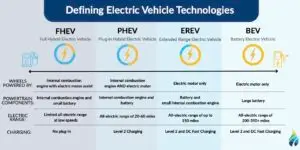
BEVs are typically what come to mind when people talk about EVs. Their architecture is the most straightforward: an electric motor powered entirely by a battery with no internal combustion engine on board. All the energy comes from electricity, and the wheels are always powered by electricity.
This means that BEVs are the only vehicles on this list that have no liquid fuel system and zero tailpipe emissions. BEVs have the lowest mechanical complexity and the highest efficiency. As a result, the cost of ownership of a BEV is often lower than that of a vehicle that requires liquid fuel and contains a combustion engine.
Best-fit use cases:
- Daily commuting and predictable driving patterns
- Urban and suburban drivers with reliable access to home, workplace, or public charging
- Fleet vehicles that make regular returns to a depot
Extended-Range Electric Vehicle (EREV)
EREVs are an electric-first powertrain where the wheels are always driven by an electric motor. The key difference between an EREV and a BEV is the presence of a, typically small, internal combustion engine that acts as a generator for the vehicle’s battery when it is depleted. The combustion engine never directly powers the wheels of the vehicle.
EREVs offer a BEV-like driving experience while reducing range anxiety and reliance on public charging infrastructure. Because of the extended total driving range provided by the generator, EREVs’ batteries are typically smaller than a BEV, reducing the cost of the most expensive component of an EV. Still, announced EREVs coming to market in the US in the next few years expect to deliver up to 150 miles of all-electric range before use of the gasoline generator is needed.
While EREVs have been in the headlines recently, the technology isn’t all that new. In fact, General Motors released a popular EREV in late 2010: The Chevy Volt. The Volt’s battery powers the car’s electric motors, and a small gasoline engine acts as a generator when the battery runs low.
Best-fit use cases:
- Drivers with long or unpredictable trips
- Rural drivers or regions with limited public charging access
- Vehicles carrying heavy loads or frequently towing
Plug-In Hybrid Electric Vehicle (PHEV)
PHEVs combine a plug-in battery with an internal combustion engine. The wheels can be powered both by the battery and the internal combustion engine. Typically, they can operate in electric-only mode for a limited range before switching to hybrid or engine operation. In contrast to EREVs, which operate as electric-first vehicles, PHEVs are more reliant on their combustion engines. As a result, PHEVs have smaller batteries and larger engines compared to EREVs.
PHEVs reduce fuel consumption for daily driving while maintaining typical habits of driving a gasoline vehicle. Providing access to level 2 charging can ease consumers into electrification without requiring major behavior changes. Many traditional gasoline vehicle models also have a PHEV variant like the Jeep Wrangler 4xe.
Best-fit use cases:
- Drivers with frequent short trips within the vehicle’s all-electric range
- Households transitioning to electrification
- Areas where charging may be available but inconsistent
Full Hybrid Electric Vehicle (FHEV) and Mild Hybrid Electric Vehicle (MHEV)
FHEVs use an electric motor to improve fuel efficiency, but they are not designed to operate as electric vehicles. They are powered primarily by an internal combustion engine, but in contrast to a PHEV, they have a smaller battery that can power the vehicle on electric-only power at low speeds and short distances. FHEVs cannot recharge their batteries with a charger. Instead, the battery recharges through regenerative braking.
In contrast to the rest of this list, MHEVs are never powered by a battery alone. In this case, the battery provides electric assist to the combustion engine during acceleration. Like FHEVs, MHEVs provide immediate fuel savings with no additional infrastructure needed. Many traditional gasoline vehicles also have hybrid variants, like the Ford Maverick.
Best-fit use cases:
- High-mileage drivers without access to charging
- Cost-sensitive buyers seeking better fuel economy
More Vehicle Options Make Electrification More Accessible
BEVs, EREVs, and Hybrids aren’t competing answers to the same question. Rather, these vehicles provide a suite of options to respond to different constraints. Understanding how they differ and where they best fit is essential for making smart investments, crafting effective policy, and accelerating clean mobility in Michigan without leaving drivers, workers, and businesses behind.
EREVs and Hybrids as a Practical Bridge
Slower-than-expected adoption of BEVs presents a real opportunity for EREVs and hybrids to act as a bridge product, electrifying more miles sooner while still meeting the needs of Michigan drivers. EREVs in particular illustrate this point. Because EREVs are driven by electricity at all times, they deliver many of the same benefits as BEVs during regular operation. Within the battery’s electric range, EREVs still produce zero tailpipe emissions. When the combustion engine is used to recharge the battery, it operates at a steady state, making it significantly more efficient than an engine directly powering a motor. Optimized RPMs (Revolutions Per Minute) and reduced complexity means that when the gasoline engine needs to be activated, the EREV has lower emissions per mile than a traditional internal combustion vehicle.
Market realities are shaping the additional focus on EREVs and hybrids. Despite the significant progress in EV charging infrastructure across Michigan, charging gaps still remain, and range anxiety hasn’t disappeared. EREVs respond to those concerns without abandoning electrification, offering a level of confidence that meets many consumers where they’re at. That confidence matters for adoption, especially in sectors where reliability and up-time are non-negotiable.
Automakers are also responding to a regulatory and market environment where affordability has become a central concern. The loss of the federal EV tax credits, along with various production credits that were intended to help develop the EV supply chain and lower production costs in the long term, have been ended prematurely. As a result, many BEVs remain priced higher than comparable gasoline vehicles. While long-term cost declines are still expected, the near-term reality is that fully electric vehicles remain out of reach for many buyers, particularly without incentives to help close the gap.
Sustaining Momentum Toward a Zero Emission Future
In this context, hybrids and EREVs offer a lower-cost way to sustain electrification momentum while the EV ecosystem continues to mature. By pairing smaller batteries with highly efficient drivetrains and, in the case of EREVs, a range-extending generator, automakers can deliver meaningful fuel savings and emissions reductions at more accessible price points. Rather than slowing the transition, these technologies help broaden participation in electrification today, keeping consumers engaged, factories running, and supply chains scaling as the industry works toward a fully zero-emission future.